Plant, Produce, and Pluck
- Shaun Hardie
- Oct 17
- 5 min read
When I think about the person of Jesus, I’m reminded that He is both the most familiar and the most mysterious person who ever walked this earth. We call Him Savior, Redeemer, and Lord of Lords. He is the Alpha and Omega, the Prince of Peace, and
yet, even after two thousand years of study, worship, and wonder — we are still discovering who He really is.
There’s a reason for that. No one can look at the sun without being blinded by its light, and no one can truly gaze at the fullness of Jesus without being overwhelmed by His glory. We know in part, as Paul said, and we live by faith until that day we see fully.
That’s why every time we open Scripture, we need revelation — not just information. We need the Spirit of God to reveal the Son of God. Because the truth is, you can grow up in church, memorize the stories, even preach sermons, and still not really know Him.
In this reflection, I want to look at Jesus through a lens that’s been there since the beginning but often overlooked — Jesus as the Gardener of Heaven and Earth. When we see Him this way, we understand His work in three simple but powerful ways: He plants, He produces, and He plucks.
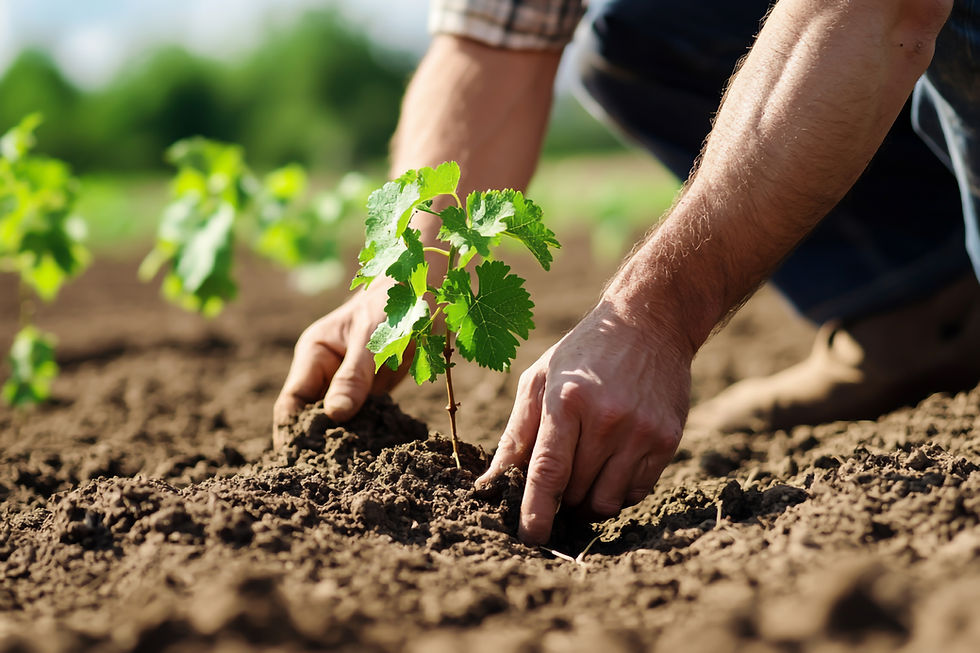
The God Who Plants
From the very beginning, God reveals Himself as both Creator and Gardener. In Genesis 1, He speaks creation into being. But in Genesis 2, He gets His hands dirty — forming Adam from dust, breathing life into him, and placing him in a garden. He doesn’t just make a man; He plants one.
Then God creates woman — not from dust, but from what could be called a “branch,” taken from Adam’s rib. Together, they were called to cultivate life, to be fruitful and multiply, to tend and steward what God made.
But in Genesis 3, two trees stand at the center of the story: the Tree of Life and the Tree of the Knowledge of Good and Evil. One leads to eternal life; the other to separation. When Adam and Eve chose disobedience, they plucked from the wrong tree — and were replanted outside the Garden.
From that moment on, Scripture traces a long story of redemption — a family tree stretching from Adam all the way to Jesus. That tree wasn’t just genealogy; it was prophecy. Genesis 3:15 promised that the seed of the woman would crush the serpent’s head. And in John 3:16, we see that seed fully revealed: “For God so loved the world that He gave His only Son.”
We live between those two trees — the one in Genesis that was lost and the one in Revelation that will restore all things. Between them stands Jesus — the Gardener who plants seeds of grace in the soil of human hearts.

The God Who Produces
After His resurrection, the first person to see Jesus was Mary Magdalene. But she didn’t recognize Him at first. John 20 says she mistook Him for a gardener.
Now, that’s not an accident. Jesus didn’t disguise Himself to hide His identity — He revealed something about His nature. The same God who once planted a garden in Eden now stands as the Gardener who cultivates resurrection.
Jesus spent three years planting the good news of the kingdom across Israel. He didn’t always go to the big cities or easy crowds. He went to small towns, remote hillsides, and out-of-the-way wells — the places that others overlooked.
When I once highlighted every place Jesus visited in Luke, I realized how much He loves small and difficult places. He traveled through Samaria — not just because it was the fastest route, but because there was a woman at a well whose heart was ready to receive living water.
Jesus wasn’t building a platform; He was working the ground. He was scattering seeds of truth and cultivating souls for God’s kingdom.
And one of those seeds sprouted in an unlikely place — in the city of Jericho, in the heart of a man named Zacchaeus.

The God Who Plucks
Luke 19 tells us that as Jesus entered Jericho, He was “passing through.” No miracles, no sermons, no plans to stop. But then Luke introduces us to Zacchaeus — a chief tax collector, a wealthy man whose riches came through extortion. The irony is striking: Zacchaeus’ name means “righteous,” yet his profession was anything but.
Unable to see over the crowd, he climbed a sycamore tree — and here’s where Luke’s Greek detail matters. The word sycamore is sukomorea — a blend of suko (fig) and morea (mulberry). It’s a fig-mulberry hybrid.
Then in verse 8, Zacchaeus confesses to Jesus, saying, “If I have defrauded anyone, I restore it fourfold.” The word defraud in Greek is sukophantes — literally, “fig-shewer.” It referred to someone who made false accusations, using words like tools of extortion — often targeting the poor.
Luke intentionally pairs these words — sukomorea (fig tree) and sukophantes (fig-shewer) — to draw a contrast. Zacchaeus sits in a fig tree that symbolizes fruitfulness, repentance, and salvation, yet he has lived as a “fig-shewer,” exploiting others.
He’s hiding in the very tree that represents what his life lacks.
It’s a picture of humanity after the Fall — running, hiding, and afraid. Just as Adam and Eve once covered themselves among the trees, Zacchaeus hides behind leaves of success and shame.
And it’s there, in his place of hiding, that Jesus stops.
“Zacchaeus,” Jesus calls, “come down quickly, for I must stay at your house today.”
That word today matters. Jesus doesn’t say “someday.” He doesn’t wait for Zacchaeus to get his life together. The Gardener stops beneath the branches and calls him down.
Zacchaeus doesn’t hesitate. He hurries down and receives Jesus joyfully. Repentance is always now. When the Spirit calls, the right time to respond is today.
And what does fruit look like when it ripens? It looks like change. Zacchaeus declares that he will give half of his goods to the poor and repay fourfold what he’s taken unjustly. Whether he’d already begun this transformation or it started right then, Jesus sees the fruit and says:
“Today salvation has come to this house… for the Son of Man came to seek and to save the lost.”
The Season Is Today
Zacchaeus didn’t find Jesus by climbing that tree — Jesus found him there. The Gardener of Heaven and Earth saw a piece of fruit ready to be plucked.
That’s grace. It’s the same grace that finds us when we’re hiding, running, or afraid.
No matter where you are, no matter what you’ve done, Jesus still stops under the branches of your life and calls you by name. He plants His word in our hearts, produces fruit through repentance and faith, and plucks what’s ripe for His kingdom.
So maybe your life feels tangled — regrets, fears, mistakes. Maybe you’ve climbed into a tree of your own making, trying to see Jesus from a safe distance. But He’s still walking by. He’s still looking up. He’s still saying, “Come down. I want to stay with you today.”
Today is the day of salvation.
Start today.
No more hiding.
No more lying.
Welcome Him in.
Jesus is the Gardener of Heaven and Earth — the One who plants truth, produces life, and plucks what’s ready for His glory. May we live each day like the soil of our hearts belongs to Him.
If this reflection spoke to you, and you’re looking for a safe space to explore how faith and emotional health can grow together, visit www.shaunhardie.com/vineyardcounseling.
I’d be honored to walk with you as you tend what matters most.


Comments